Ion Creangă Memorial House in Humulești: history and rooms
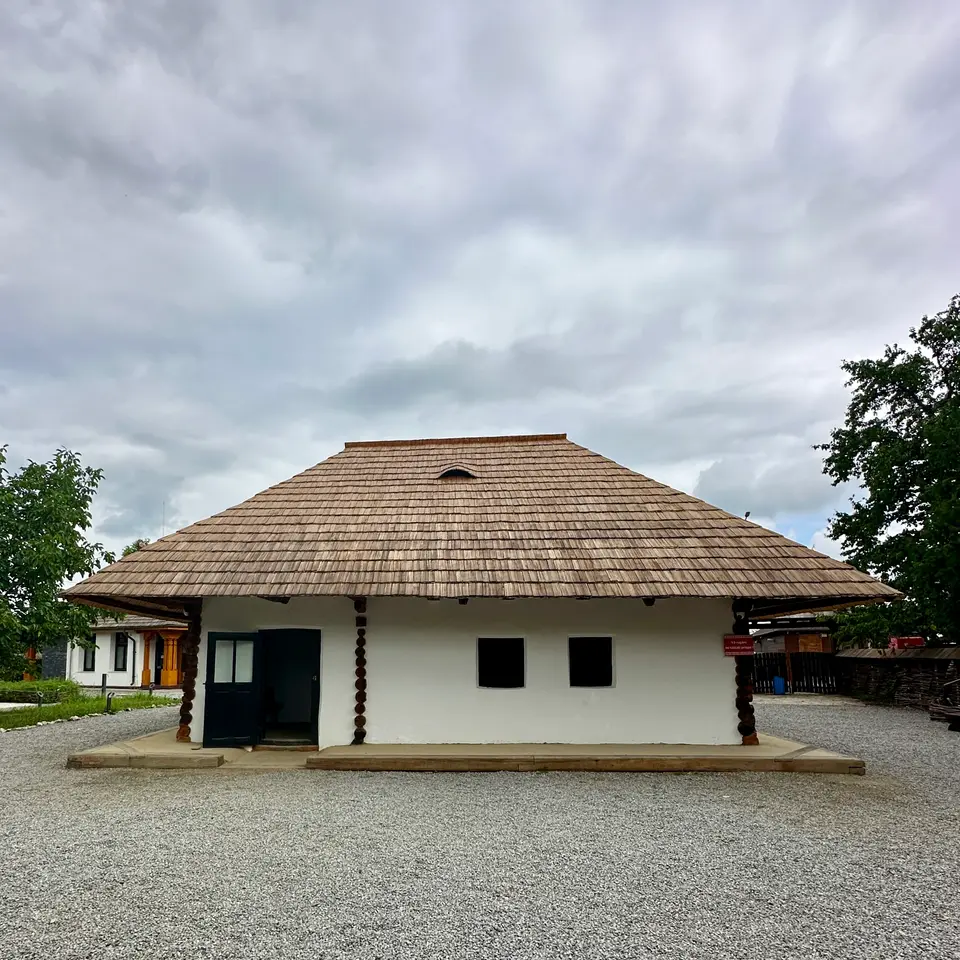
Two small rooms, an entrance hall and a loft under the shingle roof, where the boy Nică hid the hoopoe he had taken from the lime tree.
- Region
- Moldova
- Locality
- Humulești
- County
- Neamț
- Nearest national road
- DN15B
- Category
- Museum and memorial
Under the shingle roof
The doorway is low. A narrow porch, a few hands wide, keeps sudden showers off the door, and above it the broad roof of wooden shingles sweeps down. The walls are thick logs coated with clay.
Ion Creangă was born here in 1837. The house in Humulești, a village that now forms part of Târgu Neamț, is one of the most visited memorial houses in Romania, drawing more than 40,000 people a year from home and abroad. Anyone who has read „Amintiri din copilărie” (Memories of My Childhood) will find something particular in the visit, because these are the very rooms the book describes.
The building is plain, and that is what makes it convincing. It is neither a boyar’s house nor a reconstruction. These are the logs a grandfather put up for his son, lived in by several generations, mended many times and kept by the family until they became a museum. Much of what is on show belonged to the Creangăs, so the place feels like a household rather than a gallery.
From grandfather to great-niece
Petre Ciubotariu, the storyteller’s grandfather, built the house around 1830–1831 (the list of historic monuments gives 1833). He handed it to his son Ștefan, who in 1835 married Smaranda, daughter of David Creangă of Pipirig.
Ion lived here without a break from birth until 1846, and on and off until 1855, when he went to study at the seminary of Socola in Iași.
After the deaths of his parents, Ștefan a Petrii and Smaranda, the house went to the youngest daughter, Ileana. She had no children and left it to her niece Sofia, daughter of Maria, another of the writer’s sisters. Descendants of the family lived in it until 1959. Four generations, then: Petre built it, Ștefan and Smaranda raised their children in it, Ileana inherited it, and Sofia gave it away.
In 1937 the historian Nicolae Iorga took charge of its restoration. In 1944 Sofia Grigoriu, née Creangă, donated it to the Association of Teachers of Romania, and two of her children, Zahei and Antonică Grigoriu, carried on caring for it. Until 1951 it worked as an informal museum; that year, on Zahei’s initiative, the memorial museum proper opened. Further restorations followed in 1960, 1975 and 1988, the most important being the one in 1975, when the roof and ceiling were rebuilt.
The main room
The house has only two small rooms and an entrance hall. The first room, the larger one, was where the family lived, and it gathers most of the things that bring the book to mind.
The bench (lavița) stands on the right as you come in, and in winter neighbours gathered around it to work and talk. Smaranda’s dowry chest is here, with the holiday clothes hung on poles beside it. The weaving tools, the reel, the winding wheel and the bobbin winder, are set in the middle of the room so they can be seen from every side, and a wooden trough served as the cradle of the youngest child.
On a small table lie the book of hours from which Creangă first learned to read and a bust of the writer. The oil lamp, the dish rack and a set of small combs complete the family’s belongings.
The pantry and the hoopoe’s loft
From the entrance hall, where panels trace the writer’s life, a door leads into the second room, the pantry. This is where the way up to the loft begins. Nică climbed up here to hide the hoopoe from the lime tree, an episode almost every Romanian schoolchild knows.
The pantry also has photographs of Creangă and of the other house tied to his name, the Bojdeuca in Țicău, Iași. He lived there, on the street now called Simion Bărnuțiu, from 1872 until his death in 1889, and his friend Mihai Eminescu stayed with him in 1876. The Bojdeuca opened as a memorial museum on 15 April 1918, the first literary memorial museum in Romania.
Behind the house, under a steep plank roof, are household goods and farm tools of ethnographic interest. The permanent exhibition, reorganised by theme after 1989, adds letters, autographed postcards, copies of manuscripts, photographs and school textbooks from Creangă’s time, along with 14 drawings by Eugen Taru made for the 1949 edition of the „Amintiri”. Z. Grigoriu, a descendant, and Cosma, the village priest of Humulești, helped gather the objects and arrange the display.
Visiting Humulești
The house is at Strada Ion Creangă no. 8 in Humulești, with Târgu Neamț as the starting point; Humulești itself has long been part of the town. The rooms are tiny, so spend most of your time in the first one, where the objects are concentrated, and do not miss the back of the yard.
Every year the house hosts the Creangă Days (Zilele Creangă), with museum evenings, themed displays, lectures and symposia held here, at the Ion Creangă Cultural Foundation in Târgu Neamț or in local schools.
Beside the memorial house is a theme park peopled with characters from Creangă’s tales, from the goat and her three kids to the bear tricked by the fox, the first theme park in Romania built around a writer’s work. Figures from the „Amintiri” are there as well, among them aunt Mărioara, Smărăndița and Moș Chiorpec.
Closer than you think.
Good to know.
A few useful answers before you set off.
Who built Ion Creangă's house in Humulești?
Petre Ciubotariu, the writer's grandfather, built it around 1830–1831; the list of historic monuments dates it to 1833. He gave it to his son Ștefan, who married Smaranda, daughter of David Creangă of Pipirig, in 1835.
How long did Creangă live in the house?
He lived here permanently from his birth until 1846, then on and off until 1855, when he left for the seminary at Socola in Iași. His last years were spent at the Bojdeuca in Țicău, Iași, where he lived from 1872 until his death in 1889.
What objects can be seen in the house?
On display are objects that belonged to the Creangă family, among them the reel, the bobbin winder, the oil lamp, the dowry chest, the dish rack and the bench, with autographed postcards, old school textbooks and photographs. The exhibition also includes Eugen Taru's drawings for the 1949 edition of Amintiri din copilărie.
Where did Nică hide the hoopoe?
In the loft of the house. The way up begins in the second room, the pantry, reached through a door from the entrance hall. Nică climbed up there to hide the hoopoe he had taken from the lime tree.