Poiana Sibiului Wooden Church: the Church on the Hill
On the wall between nave and narthex, a Cyrillic inscription keeps the names of Empress Maria Theresa, two bishops and the four villagers who oversaw the work.
- Region
- Transilvania
- Locality
- Poiana Sibiului
- County
- Sibiu
- Category
- Church
Four names on a wall
The Cyrillic text says that “this holy and divine church” was made “in the days of the most serene queen Maria Theresa and Joseph II”, with the blessing of Dionisie Novacovici, bishop of Buda and Transylvania, and was completed at the coming of Bishop Sofronie Kirilovici. The money came from the village. The archpriest of Poiana, Oprea Picariu, looked after the work together with Iacob Simion, Bucur Ban and Stan Mănițiu. The date at the end is 12 May 1770, and a closing line adds that the church was painted by “Simion Zugravu from Craiova” in 1771.
The text holds two layers of time. Dionisie Novacovici, who gave the blessing, is called “the late”, so he had died by the time the church was finished. The work was completed when Sofronie Kirilovici arrived, a man the inscription calls “bishop of the Uniates of Transylvania”.
The language is that of its age. „Crăiasă” here means queen, „blagoslovenie” is a blessing, and the year is written „leatu 1770”. Even transcribed into the Latin alphabet, the text keeps the cadence of old church inscriptions, with long sentences that set the village’s outlay beside the names of bishops.
Few village churches tell their own story so plainly.
Biserica din Deal
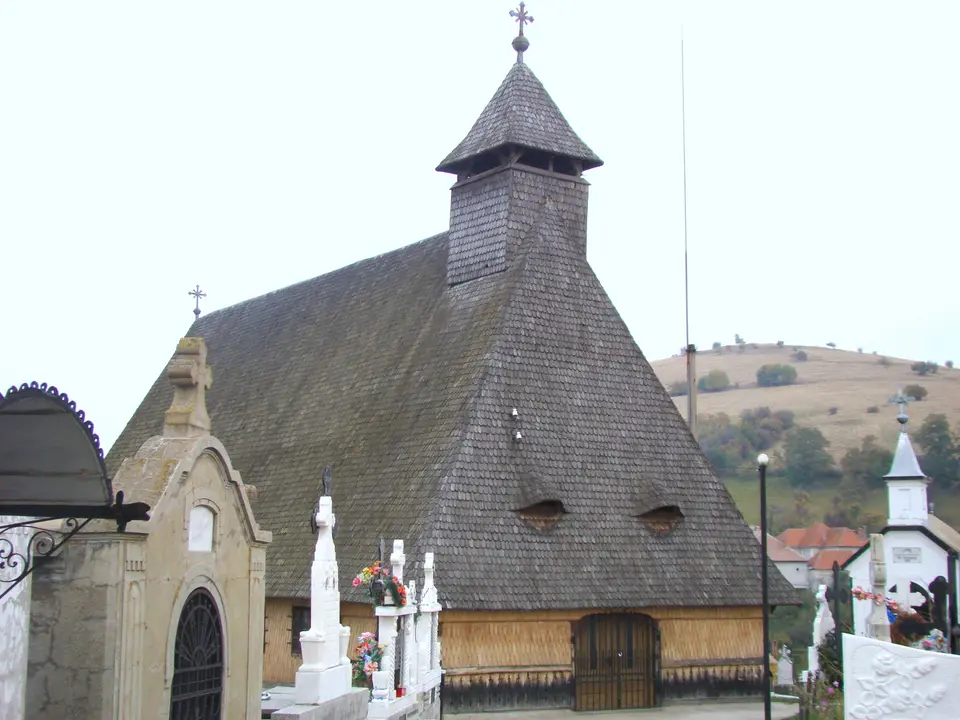
In Poiana Sibiului the wooden church goes by the name Biserica din Deal, the Church on the Hill. It is dedicated to the Dormition of the Mother of God and dates from 1766, while the inscription shows the work was finished in 1770, four years on. Building and painting did not happen together; the painters arrived only once the timber was in place. The inscription bears this out: it is dated 12 May 1770, and Simion of Craiova painted the nave the following year. Village tradition holds that another wooden church once stood nearby.
Nobody knows the name of the master who built it. The church is protected as a historic monument.
Fir, stone and shingle
The building is made entirely of fir. The walls of the nave and narthex are long beams laid one upon another on a stone foundation, under a shingle roof. Inside the nave and narthex those beams were plastered and painted, so the bare timber shows mainly on the outside.
The church is shaped like a ship, with a rounded sanctuary smaller than the rest of the building. In front of the narthex is an entrance hall beneath the bell tower. The tower is short, rising only a little above the roof, which gives the church a low, grounded profile.
The style is Byzantine, recognisable by the arched barrel vault over the interior. From outside the church looks plain, just timber, shingle and a small tower. What sets it apart becomes clear only when you step in and read the inscription.
Painters from Craiova and Săliște
The painting was done by several hands at different dates. Simion Zugravul (Simion the painter) of Craiova decorated the nave in 1771. Constantin Zugravul painted the sanctuary in 1791, and Vasile Muntean of Săliște, a village in the same Mărginimea Sibiului, painted the iconostasis in 1801. Almost thirty years separate the first and the last.
The walls were prepared with some care. Strips of cloth were first stuck over the joints between the beams, then the interior walls of nave and narthex received a gypsum plaster, and only on top of that layer did the painters begin.
Most of the wall painting is now worn away or damaged, so there are no complete scenes to look for. The movable heritage counts for more than the walls: liturgical objects, old books and icons painted on wood and on glass.
The village and the visit
Poiana Sibiului lies west of Sibiu, at the north-eastern foot of the Cindrel Mountains, in the region known as Mărginimea Sibiului. In German it was called Pojana, Pojan or Flußau, and in Hungarian Polyán or Pojána. In front of the school stands a five-metre obelisk of concrete, marble and bronze, unveiled in 1923 for the village’s dead of the First World War, inscribed on its front „Nu plângeți eroii / ci slăviți-i” (“Do not mourn the heroes, but honour them”). Ioan Branga and Ioan Ghișa, deputies to the Great National Assembly at Alba Iulia in 1918, came from the village, as did the poet and playwright Eugen Tănase and the folk singer Maria Badiu.
Once in the village, ask for Biserica din Deal; the name already points the way. A village church is not always open. Even with the door shut, the outside holds a good part of the story: the stone foundation under the fir beams, and the shingle roofline running from the hall beneath the bell tower to the rounded sanctuary at the far end. Inside, the inscription sits on the wall between narthex and nave, and the icons on wood and on glass belong to the movable heritage that now counts for more than the worn walls.
Closer than you think.
Good to know.
A few useful answers before you set off.
When was the wooden church at Poiana Sibiului built?
The church dates from 1766. The inscription on the wall between nave and narthex records that the work was completed on 12 May 1770, and the nave was painted in 1771 by Simion Zugravul of Craiova.
Who painted the church?
Several painters worked on it: Simion Zugravul of Craiova painted the nave in 1771, Constantin Zugravul the sanctuary in 1791 and Vasile Muntean of Săliște the iconostasis in 1801. The name of the master who built the church is not known.
Can the wall paintings still be seen?
The paintings on the interior walls are now almost entirely worn away or damaged. The church does keep valuable movable heritage: liturgical objects, old books and icons painted on wood and on glass.
What is the church built of?
It is built entirely of fir. The walls of the nave and narthex are long beams laid one upon another on a stone foundation, under a shingle roof. Inside, the beams were plastered and painted, so the bare timber shows mainly on the outside.