Iulia Hasdeu Castle in Câmpina: legend, museum and rooms
A father who lost his daughter at eighteen built a castle with a temple tower, a darkened room for séances and a statue no war or earthquake has touched.
- Region
- Muntenia
- Locality
- Câmpina
- County
- Prahova
- Nearest national road
- DN1
- Category
- Castle
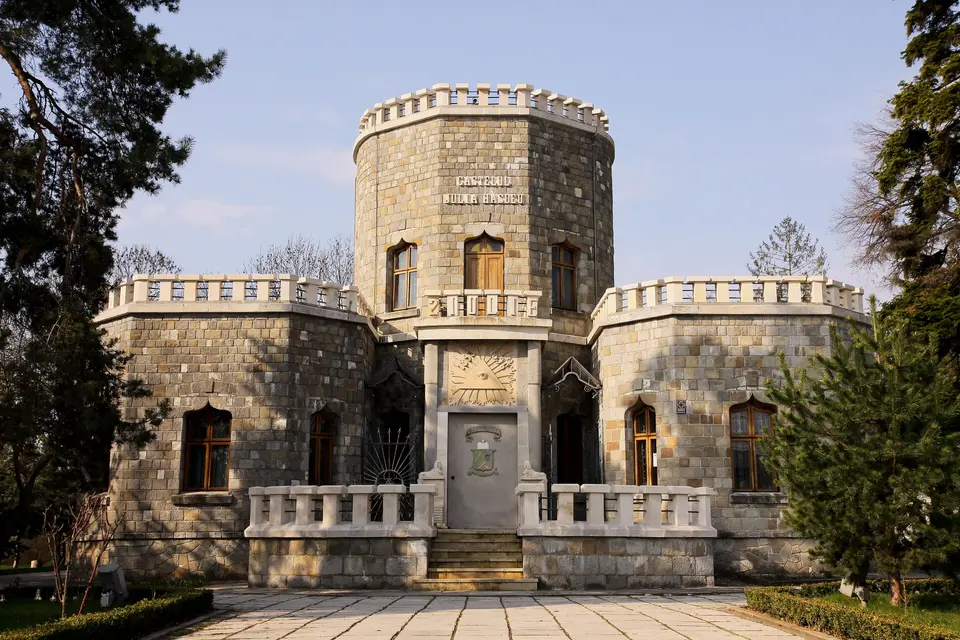
Over the castle gate in Câmpina runs an inscription nobody has managed to date: „…din Dragoste de Eminescu” (“…out of Love for Eminescu”). The building was never meant to defend anything, nor to house a court. Bogdan Petriceicu Hasdeu put it up between 1893 and 1896 to keep the memory of his daughter close.
Architects call this kind of building a folly: something dressed as a castle, with towers and battlements, raised for reasons of feeling rather than use. The plans did not come from an architect. Hasdeu drew them himself.
Iulia and the legend of the séances
Iulia Hasdeu was born in Bucharest on 14 November 1869. Her father was a philologist, historian, folklorist and writer, a member of the Romanian Academy since 1877. She was thought of as a gifted young woman: she took courses at the Bucharest Conservatoire, studied drawing and painting in Paris, attended the Sorbonne and wrote poetry and prose, mostly in French. Tuberculosis killed her on 29 September 1888. She was eighteen.
Her death changed her father. Hasdeu turned to spiritualism and began holding séances in which he hoped to speak with the daughter he had lost. This is where the legend of the castle begins, since the story goes that its shape was “dictated” to him during those sessions. Only one thing is documented: the first sketch of the castle, in Hasdeu’s own hand, sits on a page of a spiritualist manuscript dated 3 September 1893. The rest is legend.
The legend has grown since, into ghost stories and talk of the paranormal. The museum does not sidestep the subject, and Hasdeu’s spiritualist interests take up a good part of the exhibition. The castle was finished in 1896; Hasdeu died at Câmpina eleven years later.
Six rooms, one family
The tour runs through six rooms, each with its own part in the family story.
The reception room belonged to Hasdeu’s wife, also called Iulia, and keeps her marble bust. The dining room has portraits of the family painted in medallions on the walls, a photograph album turned into decoration.
The Temple is the tallest tower and the heart of the building. It has a pronaos with parallel mirrors and an altar, and in the middle of the tower, reached up metal steps, stands a statue of Jesus carved by Raphael Casciani. War, earthquakes and neglect have damaged the castle more than once, yet the statue has never been harmed. Three rooms coloured by stained glass, one blue, one red and one green, belong to the same space.
Hasdeu’s study holds portraits of the scholar, his wife and his daughter. The room of calla lilies (Camera cu cale) is Iulia’s own: her doll, her diary, her mathematics exercise book and a bust of her in Carrara marble, carved by Ioan Georgescu in 1890.
The camera obscura, the darkened room, is where the séances were held. A stone dove, an astronomical telescope, a candlestick and a small statue of Jesus remain inside. It is probably the room most people have in mind when they set off for Câmpina.
War, restoration and the 1977 earthquake
Hasdeu died at Câmpina in August 1907, and the castle needed repairs even before then. The First World War damaged it, and in 1924 the town’s B.P. Hasdeu cultural athenaeum took over the work. The Second World War made matters worse, until in 1955 the castle was entered on the List of Historic Monuments.
Restoration followed between 1962 and 1964, and the Historic Monuments Commission decided the building should become a museum. Nicolae Simache, a history teacher who founded almost every museum in Prahova County, opened the B.P. Hasdeu Memorial Museum here on 9 April 1965.
The earthquake of 4 March 1977 opened a new building site that stayed open for nearly twenty years. The Prahova culture inspectorate, Câmpina town council, the county’s history and archaeology museum and the Hasdeu Foundation eventually pooled their efforts, and the pace of the work picked up. The museum partly reopened on 17 June 1994 and was handed back to the public in full on 25 February 1995, though the works were still unfinished.
The collection beyond the rooms
Alongside the rooms, the memorial collection gathers family portraits, personal belongings, original photographs and documents, furniture more than a century old, manuscripts, and runs of the journals Hasdeu edited or wrote for. There are first editions of his books and paintings by Sava Henția, Nicolae Grigorescu, G.D. Mirea and Diogene Maillart.
If there is time for only one room, stay in the Temple, where the parallel mirrors repeat the altar without end and Hasdeu’s purpose for the whole building comes across most clearly.
Getting to Câmpina
Câmpina is in Prahova County, on the DN1 as it climbs from Ploiești towards the Prahova Valley, so the town slots easily into a day spent in the area. The castle is inside the town, and the gate is simple to reach by car or on foot.
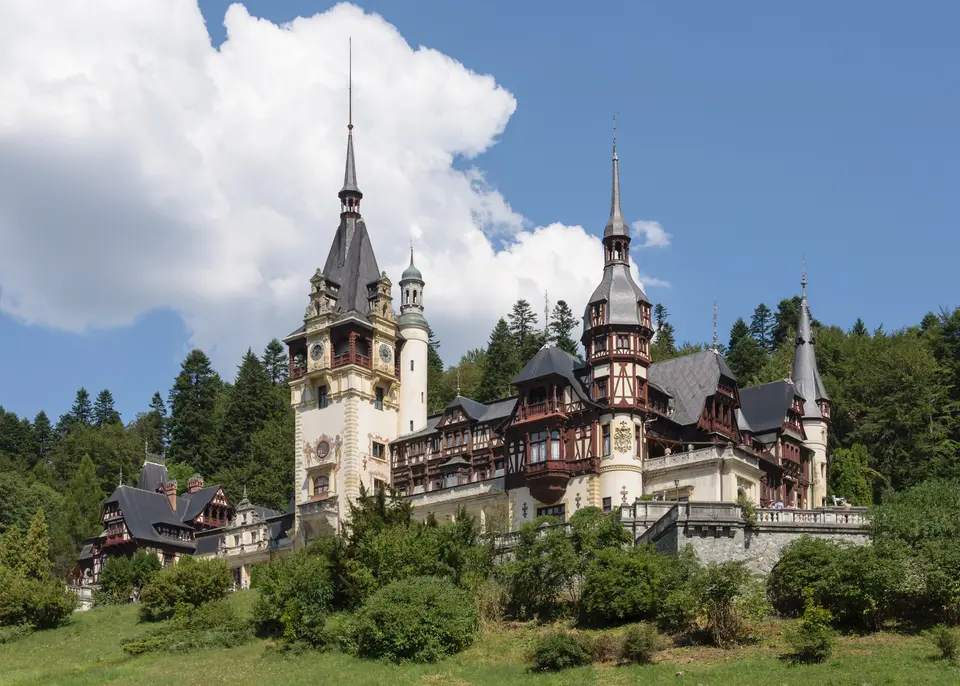
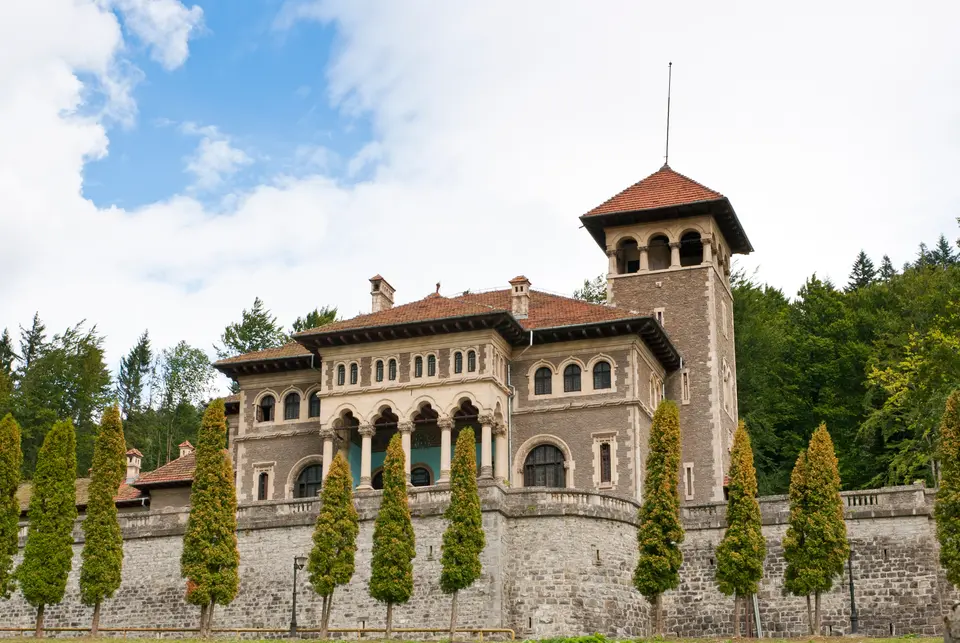
Further up the same valley stand Peleș Castle at Sinaia and the Cantacuzino Castle at Bușteni, for anyone planning a day of castles.
Closer than you think.
Good to know.
A few useful answers before you set off.
Who built Iulia Hasdeu Castle?
Bogdan Petriceicu Hasdeu, historian, linguist and writer, raised it between 1893 and 1896 in memory of his daughter Iulia, who died of tuberculosis at eighteen. His first sketch of the building is on a page of a spiritualist manuscript dated 3 September 1893.
What is the legend attached to the castle?
The legend ties the castle to the séances Hasdeu held after his daughter's death, hoping to contact her; the story goes that the shape of the building was dictated to him there. The museum preserves the camera obscura where the sessions took place.
When did the castle become a museum?
After restoration in 1962–1964 it opened as the B.P. Hasdeu Memorial Museum on 9 April 1965. The 1977 earthquake damaged it badly; it partly reopened in June 1994 and fully in February 1995.
Which room should not be missed?
The Temple, the tallest tower and the heart of the building. It has a pronaos with parallel mirrors and an altar, and in the middle of the tower stands a statue of Jesus carved by Raphael Casciani, which war and earthquakes have never harmed. It is where Hasdeu's purpose for the whole building comes across most clearly.