Sighet Memorial: the former political prison and its museum
By 1955, 54 of the roughly 200 political prisoners brought to Sighet had died here, among them former ministers, bishops, generals and academics.
- Region
- Maramureș
- Locality
- Sighetu Marmației
- County
- Maramureș
- Nearest national road
- DN19
- Category
- Museum and memorial
Shutters over the windows
Prisoners were forbidden to look out of the window. Anyone caught doing so went to the “neagra” (the black cell) or the “șura” (the barn), punishment cells with no light. Later, shutters were nailed over the windows so that only the sky could be seen from inside. The museum exists to keep memories of exactly this kind.
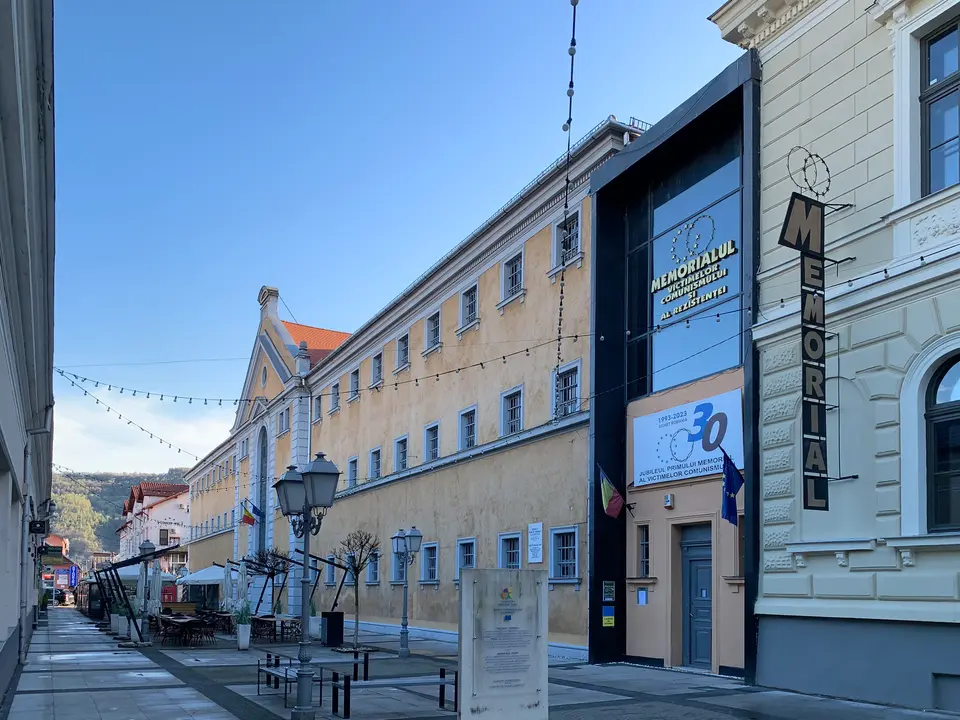
The Memorial to the Victims of Communism and to the Resistance has two parts: the museum in the former political prison in Sighetu Marmației and an international centre for the study of communism, based in Bucharest. Its stated aim is to reconstruct and preserve the memory of resistance in Romania.
A prison older than the regime
The building went up in 1897 under the Austro-Hungarian administration as an ordinary jail. Everything changed in August 1948, when a group of students, pupils and peasants from Maramureș was brought in. In May 1950 more than a hundred dignitaries arrived from all over the country: former ministers, academics, economists, soldiers, historians, journalists and politicians. Some carried heavy sentences. Others had never been tried at all.
Conditions were meant to break people. The cells were filthy and unheated, the food was wretched, and in daytime the prisoners were not allowed to lie on their beds.
In 1955, after the Romanian People’s Republic joined the United Nations and in line with the Geneva Convention, an amnesty followed. Some political prisoners were freed, others moved elsewhere, some into forced residence. Of the roughly 200 brought to Sighet, 54 were already dead. The prison went back to holding common criminals, although political prisoners still passed through in later years, mostly on their way to the town’s psychiatric hospital. It shut for good in 1977 and began to fall apart.
Who died here
The list of the dead shows how high the repression reached. Iuliu Maniu, leader of the National Peasants’ Party, died at Sighet, as did the historian Gheorghe I. Brătianu, the engineer and former minister Constantin I.C. Brătianu, the economist Mihail Manoilescu and Alexandru Lapedatu, once president of the Romanian Academy. Daniel Ciugureanu, one of the advocates of Bessarabia’s union with Romania, died in the prison on 19 May 1950 according to Securitate records. Catholic and Greek Catholic bishops are among the victims too: Anton Durcovici, Ioan Suciu, Traian Valeriu Frențiu and Tit-Liviu Chinezu.
Some came out alive, among them the Roman Catholic bishop Áron Márton and Alexandru Todea, then archpriest of Reghin and later archbishop and cardinal.
From ruin to museum
In 1993 Ana Blandiana put a proposal for a memorial on the prison site to the Council of Europe. A year later the Civic Academy Foundation took over the ruin and the Council placed the project under its patronage. Rebuilding lasted until 2000; the century-old structure was soaked with damp and needed new foundations, insulation and a new roof. The interior walls, long since repainted and bearing no trace of the 1950s, were whitewashed.
Every cell became a museum room, more than fifty of them, laid out in chronological order with objects, photographs and documents. Works given by artists stand among them, including Șerbana Drăgoescu’s tapestry “Libertate, te iubim” (“Freedom, we love you”), Christian Paraschiv’s painting “Înviere” (“Resurrection”), Ovidiu Maitec’s sculpture “Marea Neagră”, dedicated to Gheorghe I. Brătianu, and Peter Jacobi’s relief in the Map Room.
The Space for Recollection and Prayer was built in 1997 in one of the inner yards to a design by the architect Radu Mihăilescu, chosen from fifty competition entries. On the walls of a ramp that descends below ground, the names of nearly eight thousand people who died in prisons, camps and places of deportation are cut into andesite. Gathering them took ten years; most were established by Cicerone Ionițoiu and Eugen Sahan, both former political prisoners, and the London donor Mișu Cârciog paid for the building. Even so, the number falls far short of the real scale of the repression.
The Procession of the Sacrificed, Aurel I. Vlad’s group of eighteen figures walking towards a wall that shuts off their horizon, has become the emblem of the museum. It was shown in wood in 1997 and cast in bronze the following year.
In October 1998 the Council of Europe ranked the memorial among the first three sites of European memory, alongside Auschwitz and the Peace Memorial in Normandy, and in 2017 it received the European Heritage Label.
The visit and the Paupers’ Cemetery
With more than fifty rooms, the ramp of names and the bronze procession in the yard, it is better not to leave the visit for the last hour of the day.
The final part of the memorial lies 2.5 kilometres outside town: the Paupers’ Cemetery (Cimitirul Săracilor). Accounts from the period say the 54 prisoners who died were buried here secretly, at night. In 1999 the outline of Romania was traced across the cemetery’s 14,500 square metres, with dwarf pine, fir and spruce planted around it, so that as the trees grow the “country” will remain a clearing inside a green amphitheatre. A viewpoint is planned on raised ground beside the Tisa, the river that marks the border with Ukraine here. Victor Cupșa’s triptych “Requiem”, dedicated to the victims of communism in every country, hangs in the visitors’ room at the cemetery.
Closer than you think.
Good to know.
A few useful answers before you set off.
What was the building before it became a museum?
The Austro-Hungarian administration built it in 1897 as an ordinary prison. From 1948 it held political prisoners, and in May 1950 more than a hundred dignitaries from all over the country were brought here. It closed in 1977.
Who died in Sighet prison?
Among those who died here were Iuliu Maniu, Gheorghe I. Brătianu, Constantin I.C. Brătianu, Mihail Manoilescu, Alexandru Lapedatu, Daniel Ciugureanu and the bishops Anton Durcovici, Ioan Suciu and Traian Valeriu Frențiu. Of about 200 political prisoners, 54 had died by 1955.
What international recognition does the memorial have?
The Council of Europe took it under its patronage in 1994 and in 1998 named it among the first three sites of European memory, with Auschwitz and the Peace Memorial in Normandy. In 2017 it received the European Heritage Label.
What is the Paupers' Cemetery?
It is the part of the memorial that lies outside town. Accounts from the period say the 54 prisoners who died at Sighet were buried there secretly, at night. In 1999 the outline of Romania was traced across its 14,500 square metres, with dwarf pine, fir and spruce planted around it.