Kendeffy Castle in Sântămăria-Orlea: history and what to see
Above the entrance, a plaque from 1782 tells the stranger that the house takes pride not in its size or ornament but in its quiet and comfort.
- Region
- Transilvania
- Locality
- Sântămăria-Orlea
- County
- Hunedoara
- Nearest national road
- DN66
- Category
- Castle
A plaque addressed to strangers
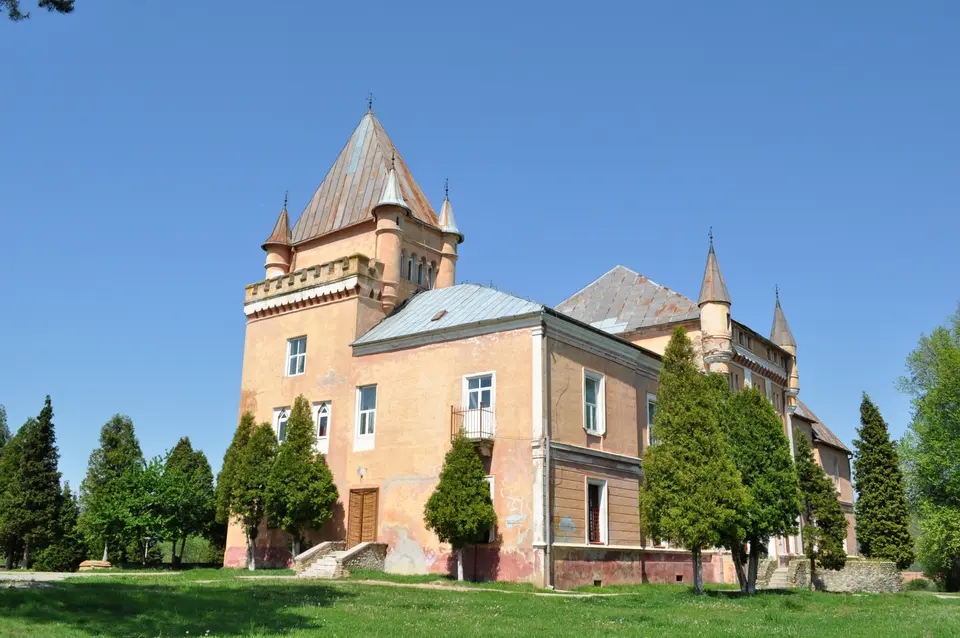
On the main front hangs a Baroque plaque carved by József Hoffmayer, a sculptor from Cluj. Traces of the Kendeffy and Bethlen coats of arms survive on it, together with a long Latin text that speaks straight to whoever arrives. It addresses the stranger directly, thanks God, “without whom all labour is in vain”, and then names the builders: the house was raised, with God’s help, by Elek Kendeffy, count of Râu de Mori and privy councillor of the imperial court and of the Grand Principality of Transylvania, with his wife Countess Krisztina Bethlen and their children, in the year 1782.
Nothing else on the façade comes close to it.
From the Cândea knezes to the Kendeffy counts
The Kendeffy family, Cândea in Romanian, was an old family of knezes, the local lords of Hațeg Country. The earliest recorded member is Nicolae Cândea, who lived around 1300 at Râu de Mori; the Hungarian name of that village, Malomvíz, later became the family’s title. His son Mihail was executed in 1356 on the orders of Andrew Lackfi, voivode of Transylvania. Some writers trace the family back to Kond, one of the seven Hungarian chieftains, while others suggest a Cuman origin.
Hațeg Country was long organised in knezates, and the historian Radu Popa identified eleven “great knezates” here. The area kept a measure of self-rule through most of the Middle Ages, with assemblies of knezes judging disputes into the 14th and 15th centuries. Like other local families such as the Kenderessy (Cândreș), the Cândea rose into the Hungarian and Transylvanian aristocracy. They turned Catholic and adopted Hungarian ways. They gained noble privileges in the 14th century, and in 1462 Matthias Corvinus granted such privileges to the Kendeffy brothers. By the middle of the 15th century they held Sântămăria-Orlea, and in the 18th century the family owned three castles.
Elek Kendeffy (1740–1783), who built this one, was high sheriff of Hunedoara County and later a councillor of the Transylvanian government. On 17 May 1762 Maria Theresa made him and his heirs counts. His grandson Ádám, a popular liberal politician, was the last man of the comital line, which died out with him in 1834. Ádám’s daughter Katinka married Gyula Andrássy, the future prime minister of Hungary, in Paris in 1856, later serving as mistress of the household to the Queen of Hungary and becoming a close friend of Empress Elisabeth.
Two periods under one roof
The castle replaced an older manor and in 1782 took on the look that descriptions of Hațeg Country call classical Rococo. Early in the 19th century it was enlarged and given a riding hall. Later in that century Árpád Kendeffy had it remade in Gothic Revival style, with the architect József Schulz working alongside the restorer and decorator Ferenc Storno.
The plan is rectangular, in three wings, and a monumental tower dominates the whole. That tower is what catches the eye first and what makes the house read as a castle. On the plaque, the couple’s names appear in their Latin forms, ALEXIUS KENDEFI and CHRISTINA BETHLENIA.
Árpád also wanted an English park, as 19th-century fashion required. The landscape gardener Wilhelm Klensky laid it out with a wide variety of trees, rare species among them.
The church next door
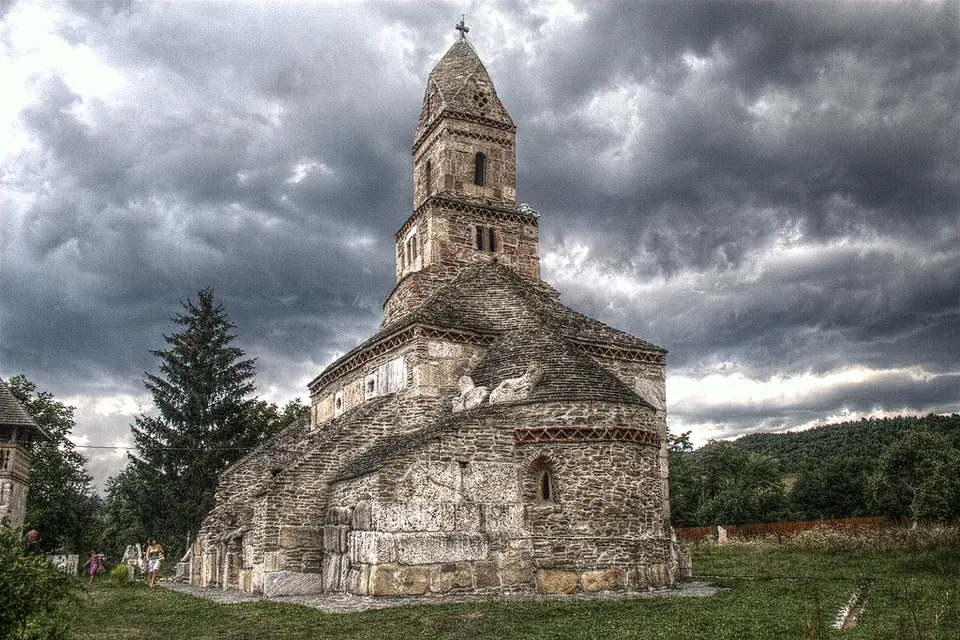
A short walk away, on a plateau at the edge of the village, stands the church now used by the Reformed congregation, one of the oldest in Romania. It went up towards the end of the 13th century in rough stone, in the passage from Romanesque to Gothic: a nave with a flat ceiling, a rectangular sanctuary under a ribbed vault and a square tower of five storeys on the west front. A Latin inscription on the south wall records its dedication to the Virgin in 1311, and the nave paintings of the same year are considered the oldest surviving painted ensemble in the country.
The link with the castle family runs both ways. The later painting in the sanctuary was most likely paid for by the Cândea of Râu de Mori once the village was theirs. And the first fragments of fresco were freed from limewash in 1869 by Ferenc Storno, the man who also decorated the castle.
After nationalisation, and the visit
The communists nationalised the castle in the late 1940s. Summer camps filled its park in the 1960s, and in the 1980s the Hunedoara county administration turned the building into a hotel. Today it is a listed historic monument.
Sântămăria-Orlea is the seat of the commune of the same name, south-east of Hațeg, with the DN66 close by. A document of 1331 calls it “villa Sancte Marie”. The village lies about 3 km south-east of Hațeg, on the left bank of the Strei, and later records give it other names: Bodogazzonfalwa in 1509, Orlja Bóldogfalva in 1800. In 1850 it had 272 inhabitants, 218 of them Romanian and 44 Hungarian.
The commune also holds the royal fortress of Hațeg at Subcetate. Nearby are the Nopcsa family’s castle at Săcel and the dinosaur fossil reserve at Sânpetru, part of the Hațeg Country Dinosaurs Geopark, a reminder that dwarf dinosaurs lived here in the Cretaceous, when the area was an island.
Closer than you think.
Good to know.
A few useful answers before you set off.
Who built Kendeffy Castle?
Count Elek Kendeffy and his wife, Countess Krisztina Bethlen, built it in 1782 on the site of an older manor house. In the second half of the 19th century Árpád Kendeffy had it remodelled in Gothic Revival style.
What does the plaque on the façade say?
The Baroque plaque by the Cluj sculptor József Hoffmayer bears traces of the Kendeffy and Bethlen arms and a Latin text. It says the house stands out for its quiet and comfort rather than its size or decoration, and that Elek Kendeffy built it in 1782 with his wife and children.
What happened to the castle after the Second World War?
The communist regime nationalised it in the late 1940s. Summer camps were held in its park in the 1960s, and in the 1980s the Hunedoara county administration took it over and turned it into a hotel.
What else is there to see near Kendeffy Castle?
A short walk away stands the church now used by the Reformed congregation, one of the oldest in Romania, whose nave paintings of 1311 are considered the oldest surviving painted ensemble in the country. Nearby are also the Nopcsa family's castle at Săcel and the dinosaur fossil reserve at Sânpetru.