Oravița Station: Romania's first station and the Anina line
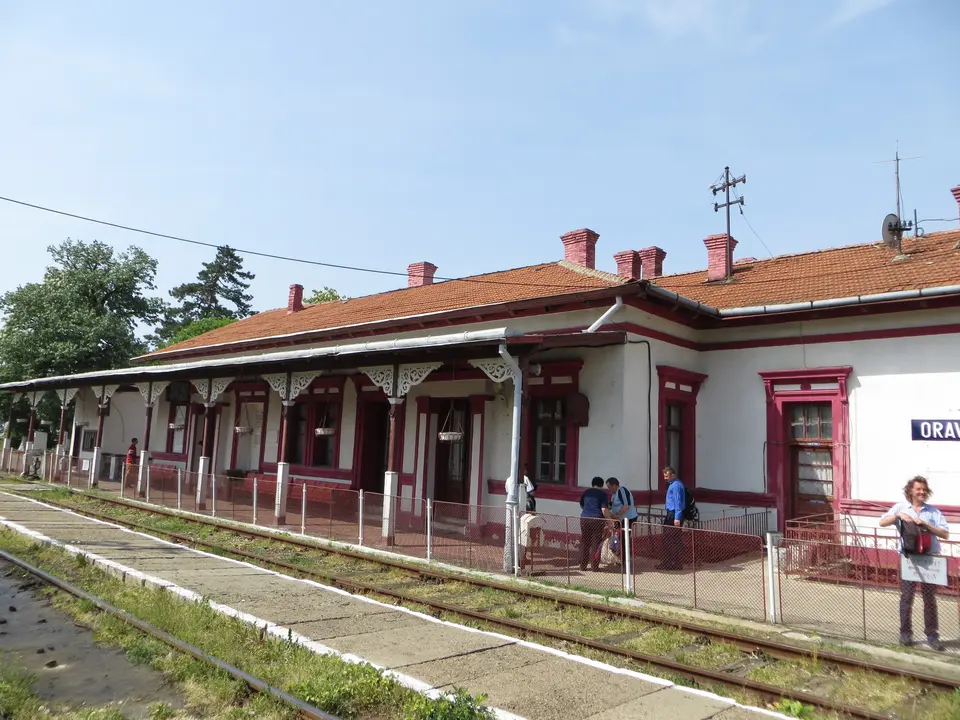
A station completed in 1847, with its platform on the first floor, built together with the line that carried coal from Anina down to the Danube.
- Region
- Banat
- Locality
- Oravița
- County
- Caraș-Severin
- Nearest national road
- DN57
- Category
- Museum and memorial
A platform upstairs
At Oravița the platform is not at street level, as it is at nearly every other station in the country. It is on the first floor. A small thing, and the first one you notice. Around it, the town sits at the foot of the Anina Mountains, where the lowland meets the hills.
Oravița station, also known as Gara Oravița Română, is a historic monument and holds the title of the first railway station in Romania. Its construction was completed in 1847. To put the date in perspective, the Liverpool and Manchester Railway had opened in 1830, so the iron road reached the Banat only a few years after that.
Coal, florins and a route to the Danube
The station was built neither for tourists nor, at first, for passengers. Its reason was coal. The Oravița–Baziaș line was laid to carry coal from Anina through Oravița to the Danube at Baziaș, and the investment cost five million florins.
The original route linked Oravița with Răcășdia, Vrăniuț, Berliște, Milcoveni, Iam, Straja, Iasenova, Biserica Roșie, Biserica Albă, Vracevgai, Socol and, at the end, Baziaș. Work lasted from 1846 to 1854, and the line opened on 20 August 1854. Passenger service was organised only from 1856.
It was run by the privileged Austrian railway company and, after 1867, by the Privileged Austro-Hungarian State Railway Company, known by its German initials St.E.G. Today the line is closed and no operator runs trains on it. Most of the stretch between Iam and Baziaș, which crossed what is now Serbia, has been dismantled.
Oravița did not become a railhead by chance. It had long been a mining town, with copper mines worked under both Ottoman and Austrian rule, and after the Banat passed to the Habsburgs in 1717, mining specialists were brought in from several Austrian provinces. The station arrived in a place that already lived from what it took out of the mountain.
The line that climbs to Anina
If the Baziaș line explains why the station exists, the line to Anina explains why railway enthusiasts make the journey. The Oravița–Lișava–Anina railway opened on 15 December 1863 and is the first mountain railway on Romania’s present territory (the fourth railway built there overall). Construction began in 1861 in the western Banat Mountains, a region hard to reach.
From Oravița, at an average altitude of 220 metres, it climbs onto the Semenic plateau along a corridor that no road follows. Over its 33.4 kilometres it gains 339 metres, through 14 tunnels with a combined length of 2.1 kilometres and across 9 viaducts. Some curves have radii of only 104 metres and gradients reach 21 per thousand, figures that have often drawn comparisons with the famous Semmering railway in the Austrian Alps.
A route like that needed engines designed for it. The engineer Pius Fink drew up a tank locomotive with five coupled axles, able to climb the gradients without overloading the rails of the day, and four were built between 1861 and 1867 at the St.E.G. locomotive works. Other types followed in the 1880s, then in 1930 locomotives made at Reșița specially for this line. More powerful engines came after 1956, raising the load per train from 150 to 235 tonnes, and by the late 1970s trains on the section were hauled by two locomotives at once. From 1980 pairs of diesel-electric engines took over, pulling 600 tonnes a train.
The section belongs to the listed “Baziaș–Oravița–Anina railway” site, and the station building at Anina, at the far end, is a historic monument too.
The town around the station
A railway viaduct appears in Oravița’s coat of arms, on a blue field below a red curtain with two theatre masks, and the arms sum up neatly what the town has to offer. Besides the station there is the Mihai Eminescu Theatre, built in Viennese Baroque style in 1816–1817 and the oldest theatre in the Banat; Emperor Francis I and Empress Caroline Augusta attended its opening in October 1817, and it now houses a museum of the theatre and the town.
On Strada 1 Decembrie 1918 stands the Black Eagle pharmacy („La Vulturul Negru”), the oldest mining pharmacy, founded in 1793 and on record from 1796 according to the plaque at the door, set up by the Knoblauch family of pharmacists. On the Oravița stream, Lacul Mare and Lacul Mic sit behind the first gravity dams in Romania, built between 1723 and 1733 for washing ore.
Getting there and what to check
Oravița lies in the south-west of the country, in Caraș-Severin County, ringed by the hills of Tâlva Mare, Tâlva Mică, Colilia and Prisaca, with the Anina Mountains behind. The station is in the town itself, and from the tracks the upstairs platform shows in full.
Unlike the closed Baziaș line, the Anina line still has a timetable, and it can change from year to year. Winters here are milder than elsewhere in the mountainous Banat and spring comes early, though the Coșava wind can blow very hard.
Closer than you think.
Good to know.
A few useful answers before you set off.
Why is Oravița considered Romania's first railway station?
The building was completed in 1847, together with the first railway on Romania's present territory, the line from Oravița to Baziaș. The line was built between 1846 and 1854 and opened on 20 August 1854.
Do trains still run on the old Oravița–Baziaș line?
No. The line is closed and no operator runs on it. The section between Iam and Baziaș, which crossed what is now Serbia, has largely been dismantled.
What makes the Oravița–Anina line special?
Opened on 15 December 1863, it is the first mountain railway on Romania's present territory. It has 14 tunnels and 9 viaducts, curves with radii as tight as 104 metres and gradients of up to 21 per thousand, which is why it has been compared with the Semmering line in Austria.
What is unusual about the station building?
Its platform is on the first floor, not at street level as at nearly every other station in the country. To take it in fully, view the building from the tracks as well as from the front.