Oravița Theatre: history, Eminescu and the theatre museum
A mining town at the foot of the Anina Mountains built itself a playhouse on a Viennese model, and the Emperor of Austria came in person to open it.
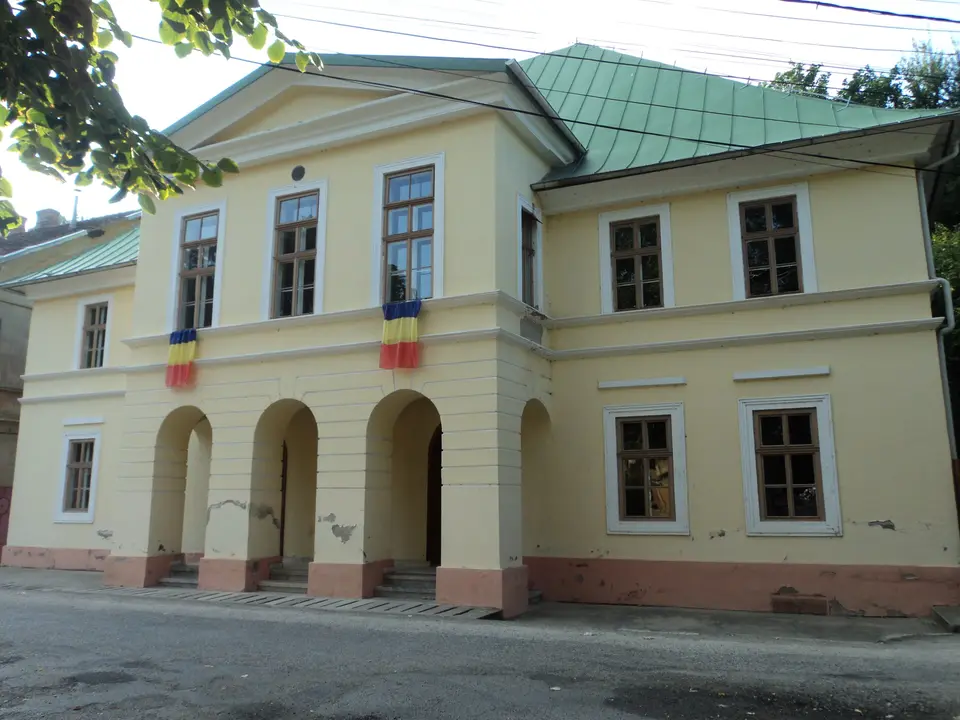
- Region
- Banat
- Locality
- Oravița
- County
- Caraș-Severin
- Nearest national road
- DN57B
- Category
- Museum and memorial
A subscription list from 1817
Among the exhibits in the old auditorium is a sheet of names and sums: the original subscription list for building the theatre, dated 1817. Oravița was no provincial capital, just a town of miners, copper smelters and Austrian officials, yet its people raised the money for a playhouse modelled on the Burgtheater in Vienna.
What they got was the oldest theatre building in the Banat and the first in the region made of stone, put up in 1816–1817 in Viennese Baroque style. It is also said to have been the first building in Europe lit by acetylene lamps. It is a scaled-down version of the Viennese house, but a fully working one.
Why a theatre here
The answer lies in the town’s past. After 1717, when the Banat came under Austrian rule, Emperor Charles VI and then Maria Theresa granted privileges that drew mining specialists from every province of Austria, and Oravița became the centre of the mining district. Copper from the mines of Oravița and Ciclova Montană was processed in town, and in 1815 Vienna opened a mint at Ciclova that struck florins stamped with the letter “O”.
Settlers arrived in waves, first from Austria, then from Oltenia and Wallachia (woodcutters, charcoal burners and carters), and between 1760 and 1770 Aromanian merchants made their homes here too. A mixed and fairly prosperous community of that kind wanted schools, a pharmacy and somewhere to watch a play. The Black Eagle pharmacy, founded in 1793, still stands in the town as well.
An emperor at the opening, a poet as prompter
Emperor Francis I of Austria and Empress Caroline Augusta inaugurated the theatre in 1817, staying at the Hotel Imperial in Oravița from 7 to 10 October. For a provincial town on the edge of the empire it was a rare occasion.
In the decades that followed, companies from Austria, Germany and Hungary played here, then actors from the National Theatre in Bucharest. Ciprian Porumbescu’s Romanian operetta “Crai Nou” was first performed on this stage, and George Enescu also passed through Oravița.
The best-remembered episode, though, belongs to 1868. That summer Mihail Pascaly’s company, with Matei Millo and Fanny Tardini-Vladicescu among the cast, toured Brașov, Sibiu, Lugoj, Timișoara and Arad before reaching Oravița. The company’s prompter was the young Mihai Eminescu. In Oravița they gave two performances, on 1 and 2 September 1868. On the same tour Iosif Vulcan obtained from Eminescu the poems “La o artistă” and “Amorul unei marmure”, which he then published in the magazine “Familia”.
No other name has stayed attached to the building the way his has, and today the theatre carries it.
Inside the old auditorium
The building houses the Museum of the History of the Theatre and of the Town of Oravița. Its permanent exhibition opened in 1968 and was rearranged in 1973 and 1982. There are sections on history, historical geography, ethnography and folklore, a documentary collection and the “Sim. Sam. Moldovan–Ionel Bota” library of old books and newspapers.
Among the finest pieces are the posters of G.A. Petculescu’s company, the first professional troupe in Transylvania and the Banat, which show what was staged in a provincial town in the 19th century and how performances were advertised. Costumes, accessories and props sit beside prints and manuscripts, the most direct link to how theatre was made here.
The hall and the stage are part of the visit. The building was also home to the town’s Music and Song Society, and today it hosts book launches, lectures and meetings with writers.
On the road to Oravița
Oravița lies in the south-west of Caraș-Severin County, beneath the Anina Mountains, surrounded by hills with names like Tâlva Mare, Colilia and Prisaca. Roads come in from Reșița and Anina as well as from Moldova Nouă and Bozovici, so the town can be approached from several sides.
The theatre stands at Strada Mihai Eminescu 18. Its library and documentary archive come from the collection of Professor Ionel Bota, whose name the library shares and who also wrote a history of the theatre from 1817 to 1940; an earlier one by Ion Crișan, published in 1968, covers its first 150 years. The climate is gentler than in most of Romania, with a Mediterranean touch. Oravița holds the national June temperature record of 42 °C, set in 1938, so summers can be very hot, while spring and autumn suit a walk around town.
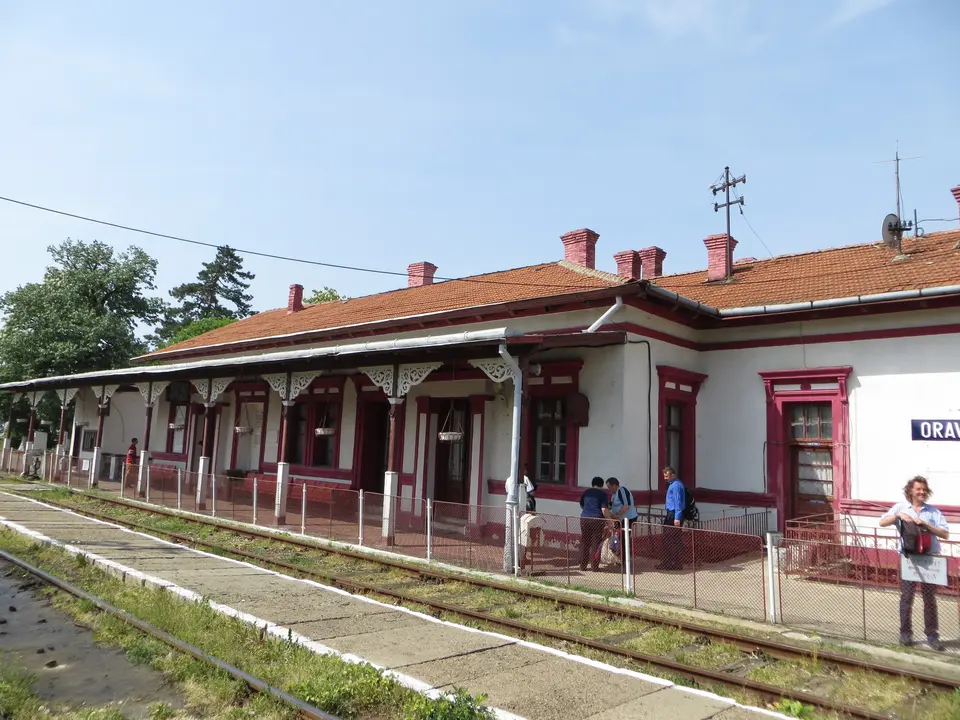
The railway makes a natural second stop. The Oravița–Anina line, opened in December 1863, is Romania’s oldest mountain railway, climbing towards the Semenic plateau through 14 tunnels and over 9 viaducts. The town’s coat of arms puts a railway viaduct just above the two theatre masks.
Closer than you think.
Good to know.
A few useful answers before you set off.
How old is the theatre in Oravița?
It was built in 1816–1817 in Viennese Baroque style, on the model of the Burgtheater in Vienna, and opened in 1817 in the presence of Emperor Francis I of Austria and Empress Caroline Augusta. It is the oldest theatre building in the Banat.
What is the link between Mihai Eminescu and the theatre?
In 1868 Eminescu was prompter in Mihail Pascaly's company, which gave two performances in Oravița on 1 and 2 September 1868 during a summer tour of Transylvania and the Banat. The theatre now bears the poet's name.
What can be seen inside today?
The building houses the Museum of the History of the Theatre and of the Town of Oravița, with sections on history, historical geography, ethnography and folklore, a documentary collection and a library of old books and press. Posters, manuscripts, costumes and props are on show, including the original subscription list for the theatre.
What else is worth seeing in Oravița?
The Oravița–Anina railway, opened in December 1863, is Romania's oldest mountain railway, climbing towards the Semenic plateau through 14 tunnels and over 9 viaducts. The Black Eagle pharmacy, founded in 1793, also still stands in the town.